Friday, August 24, 2018

Trying to thin out the book collection

We have books all over the house. A couple of weeks ago we saw an amusing cartoon about books, which I posted on FaceBook. Then my husband was inspired to go around photographing (almost) all the books we have in every room.
To get rid of those that have some current value, (mostly books for educators or students of science and math), I have an Amazon Sellers Account. Here are the books currently on my little bookstore shelves:

But I thought you might be amused at all those pictures my husband took around the house after seeing this cartoon:
Originally, we figured they'd all fit into the room we dubbed the Library/Music Room:


Our separate offices have our own books that would be of little interest to the other of us.
Here is John's office:


And here is mine, a couple of weeks ago:


We have a room divider with cookbooks in the kitchen, and a bookcase with biographies as well as one for books for the Little Free Library ended up in the dining room.


.


But one place we were determined wouldn't have books is the bedroom. But....


If you happen to see a book (or more) that interests you, please contact me. Maybe we can arrange a gift or sale.

Monday, March 19, 2018

No more pencils, but lots of books!

I finally decided to finish my short career as science and math teacher. It became very difficult to find jobs (maybe ageism had a role there.)
Also, I didn't think it was "fun" anymore. Students were more interested in checking out their laps, than working together in teams to learn. When I started all this, very few students had cellphones, so managing a classroom with 35 cellphones was not part of my teacher-ed curriculum. I tried everything various teacher-blogs suggested, including teaching students where to find useful math and science information and apps, but the last classes I taught used them instead to look up worksheets I sometimes used, to find the "correct" answer, or to text (almost always wrong) quiz answers to each other.

So now I occasionally help a student get over a hump in math or science, and otherwise spend a lot of time reading and learning languages. I've continued with Spanish, which I started in earnest to communicate with some of my students, and have also been playing with DuoLingo to learn some Modern Greek and Catalan (because we visited Barcelona last year.)
 
And the best part is my Little Free Libraries, both of them, one for little kids (above), and one for older kids and adults (to the left). I can't help reading book reviews for children's books, and trying to find them in used or otherwise inexpensive versions. So I've been reading Young Adult literature as well as grown-up books. And I enjoy talking with neighborhood kids as they select books as well.

I've also discovered the Book website GoodReads, and enjoy participating in book clubs there.
But I doubt I'll be back writing on my blog again. But you never know!

Saturday, February 20, 2016

A good teacher...

A new student from another school district wrote this for me soon after he arrived. He said he'd seen it on a poster in the District office. I love that a student can appreciate how hard we work!


Why some of us don't have one true calling: TED talk

I love this TED talk. It sounds a lot like me!


In college I was truly split between the science career I'd been planning all through high school, and my new-found fascination with languages, historical linguistics, and just learning lots of languages, just to see how they worked. Although I can say I speak Danish fluently and German close to fluent (although not up-to-date!), I can also get along in French and communicate in something vaguely like Spanish with my students. But along the way I've also dabbled in Sanskrit, the holy language of the Hindi religion, as well as Greek, Latin, Lithuanian, Russian, Finnish (and a dab of its close relative, Estonian on a visit there) and recently Italian through RosettaStone and DuoLingo.

I also sing in the Claremont Chorale, play the piano, and was considered something of a folk singer in college, playing my guitar and singing songs of Pete Seeger andJoan Baez, as well as a variety of German, French and Russian folksongs. And then there are all the clothes I've made for my children and grandchildren (and their dolls). There's the diaper service I ran for 5 years in Denmark, too, and years as a technical writer. And now I'm back where I started, teaching chemistry and physics in high school.

Many of my students feel the same way. We have to support them to experiment with their lives, but also realize that they will have to earn a living some day.

One of my students is totally into dancing, and every day he manages to come to class he says "I hate being here, I hate school!" But if I can get him to answer a question, I know he's been listening, and then he's sometimes hard to stop. He answers all my questions before anyone else has a chance. He dominates his group on their activities, and even once admitted that he used to think he'd become a biochemist. But right now that dancing is all he can think of.

Friday, July 10, 2015

Our Little Free Library

I have wanted to have a Little Free Library ever since I heard about them. Our home is situated perfectly for one, on a corner lot at the entrance to a small new subdivision with residents of all ages. When we had our front yard redone to make it even more drought-resistant, I asked the landscaper to put in a post for the library and ordered a "Purple Pickle" library from the website. Not only do the colors match some of the flowers in our yard, it was also a special, arriving with a package of 10 children's books.

We finally got it put up this week, and there has been movement in the book collection ever since. I put in a variety of children's books, including some wonderful kids' science books from the National Science Teacher Association, some books on how to make math easier for our teenagers and a few books for the parents and grandparents. We have loads of books, so I'm hoping we can send a lot of them through our community library!

The neat thing about the Little Free Library is that users can take a book and maybe replace it with something else. There is a constantly changing variety of books in our little library, which is fun to see. People took to it immediately.

As you can see in the picture, part of the new landscaping is a new path with a couple of steps and a little bridge over our "Arroyo Seco", which the kids have put to use as short cut and place to sit while looking at the books. It's as if our corner front yard has become public, at least for the children, which is fun to watch.  I noticed that the library is a little high for the smallest children to see in, so I've asked the landscaper to make a step in front of it, which can also serve as a seat.

Wednesday, July 8, 2015

Remaining Awake During Revolutions

Class of 65: SEMPER PROVOCANTES

My class of 1965 reunion at Oberlin College was so inspiring, I've had a difficult time trying to figure how to write about it. Sort of like authors trying to write about their war experiences (Kurt Vonnegut's Slaughterhouse 5) or the death of a close family member (Joan Dideon's Year of Magical Thinking). Emotions need time to settle.

The early 60s were an exciting time, and the students of Oberlin College were right in the middle of it (although I stood mostly admiringly on the sidelines.) Therefore we were all issued caps at reunion with the motto, Semper Provocantes, which speaks well for many things in our generation. Oberlin students helped coal miners unionize to fight Big Coal - which I do now in connection with fighting Mountaintop Removal in the Appalachia I came to love while a student at the University of North Carolina. Others went all the way South to work with voter registration, and to rebuild a burnt church. You can read about some of that in this article: Memories of a Movement: Oberlin Alumni reflect on their time in the civil rights movement of the early 1960s.

I at least became a folk singer, and folk singers, like Joan Baez and Pete Seeger, who visited campus, sang protest songs. My repertoire was Pete Seeger and folk songs in languages  I was studying, like German, French and Russian.

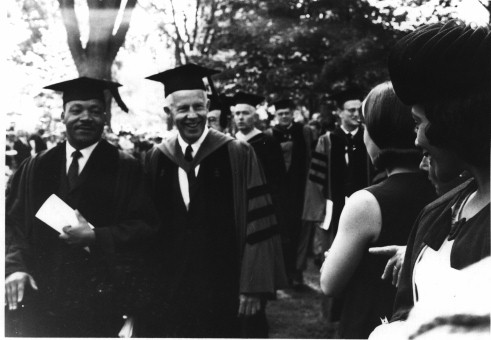
Because students from our campus were so active in voter registration, Dr. Martin Luther King presented the Graduation Address at our Commencement, calling it: Remaining Awake Through a Great Revolution. He told about how Rip Van Winkel slept through the American Revolution and was astonished at what he experienced when he awoke.

Dr. King's words are as important to us now as then, because there are many revolutions we are still fighting, some of which we didn't even think about back then. Women's Lib was not being discussed yet, nor were gay rights. We had some idea that we were messing up the environment because of Rachel Carson's Silent Spring, from the spring of 1962. But our concern was also awakening about the conflicts in the far East, which became the Vietnam War, maybe because some of us would be drafted to fight that war.
"We must live together as brothers, or die together as fools", Dr. King said.
But I think we have not yet learned to live as brothers (and is brothers really a good image? Maybe friends would be better.) There are still many revolutions, pitting brothers (and sisters) against each other, and our students must be prepared to understand what the revolutions are about, and to also understand that we must live together in peace if our world is to endure.

The  Class of 2015 was almost as privileged as we were, because Michelle Obama spoke to them, quoting liberally from the words of Dr. King. You can read the transcript

And the truth is, graduates, after four years of thoughtful, respectful discussion and debate ..., you might find yourself a little dismayed by the clamor outside these walls—the name-calling, the negative ads, the folks yelling at each other on TV. After being surrounded by people who are so dedicated to serving others and making the world a better place, you might feel a little discouraged by the polarization and gridlock that too often characterize our politics and civic life.

And in the face of all of that clamor, you might have an overwhelming instinct to just run the other way as fast as you can. You might be tempted to just ... find a community of like-minded folks and work with them on causes you care about, and just tune out all of the noise. And that’s completely understandable. In fact, I sometimes have that instinct myself—run! ...

But today, graduates, I want to urge you to do just the opposite. Today, I want to suggest that... you need to run to, and not away from, the noise. ... Today, I want to urge you to actively seek out the most contentious, polarized, gridlocked places you can find. Because so often, throughout our history, those have been the places where progress really happens—the places where minds are changed, lives transformed, where our great American story unfolds.
One alumnus (a lowly sophomore when I graduated) said.
"I think it's important for young people today to understand how much power there is in not knowing what you can't do."  Charlie Butts, Oberlin College '67
That is the glory of being young. You don't really accept "no" but try anyway. I'm afraid many high school students have forgotten that, though. Too many times have teachers and parents told them what to think, what's right, what is expected of them, and they have lost their curiosity, and believe the adults who say "it can't be done," or "it can only be done this way."

I think it is a very necessary role of teachers to awaken students' curiosity, not squelch it. Encourage students to join whatever revolutions they see, while preparing them to think clearly about the options available to them.

As a teacher, I want my students to be literate in science, since it is an important part of today's revolutions. I want them to be able to read and discuss and think and discuss some more. But I don't want them lost to demagogues who mislead them with pseudoscience, or incomplete interpretations of history. When we set students free at graduation, let them be prepared for the big and complicated and confusing world we have provided for them.

Monday, April 27, 2015

Modeling

This is a great video that tells about the strategy I'm trying to use in physics:

Notice how the modeling concept works through these phases:
  • Model Development 
  • Model Deployment 
  • Model Failure 
He talks about how modeling goes from the concrete to abstraction. I once tutored a student in Physics who had been a straight A student until Physics Senior Year. It turned out his teacher showed them how to derive equation after equation to define physics concepts, but the only labs they did were after the test, as a reward. The student and I figured out together how the concepts worked, and he started getting A's again!

For more information, look at the American Modeling Teachers' Association (AMTA), where members can find a full curriculum for Physics, Chemistry, Physical Science, and now also Biology. The speaker also mentions the Modeling website at Arizona State University, where the strategy originated.

Tuesday, April 21, 2015

Solving Difficult Problems

Don't Panic!

My students have been brought up in the math tradition of fast is best, and there's only one way to solve problems, using tried and "true" procedures. Their previous physics teacher had selected a college textbook for them (thinking they were all AP-Physics students, which they were not, even though they were all very intelligent in their own ways.) The textbook took great pride in generating formulas for every conceivable situation, so my students had great difficulty accepting my collection of 4 formulas on the board, which I said would cover any situation they could think of that applied to Newton's 3 Laws. Time and again one of the students (usually the ones who had gotten high grades from the previous teacher) would bring that textbook to me and ask if some version of a formula was the right one to use for a particular problem. I always said, "No, use one of the four on the board." This was very difficult for them to accept until I discovered a wonderful video clip, which I show below.
I have been auditing a MOOC with Stanford Professor Keith Devlin, based on his book Introduction to Mathematical Thinking. ("Auditing" means, I'm not taking it in the allotted time, nor submitting assignments, but I'm at least watching all the video lectures.) In the very first week, he offered a video, which I called How to Solve Difficult Problems.

Techniques the Pros Use to Solve Hard Math Problems from Keith Devlin on Vimeo.

I think showing a clip from this (about half) was the turning point in getting students to understand what I was talking about.The course is intended to introduce HS students to what college math (beyond calculus) will be like, and I am auditing it, so I can mentor my students in what they need to know to succeed in college. One important thing is problem solving - not just math and physics, but everyday life away from home. So we talked about his recommendations
  • Don't panic
  • take your time
  • take a break
  • draw a picture or diagram
  • write down everything you know
  • learn from your mistakes, etc
in connection with problem solving in everyday life - deciding which college to apply for or accept, whether to buy a car, and which one, whether to date someone, etc. 
And then we applied these concepts when solving physics problems. After the video they had a much better understanding of how to solve problems. Interestingly enough, on the last test I gave them, they were very good at solving problems where they were expected to model the problem in 6 different ways, but they did poorly on multiple-choice, where I figure many rushed through in their usual manner, bringing in all their physics misconceptions.

Monday, April 20, 2015

A Blessing For One Who Is Exhausted

Sometime Doing the Impossible can leave you exhausted. This poem that a friend had posted on Facebook has been very helpful:

A Blessing For One Who Is Exhausted, by John ODonahue

From To Bless the Space Between Us: A Book of Blessings

When the rhythm of the heart becomes hectic,
Time takes on the strain until it breaks;
Then all the unattended stress falls in
On the mind like an endless, increasing weight,

The light in the mind becomes dim.
Things you could take in your stride before
Now become laborsome events of will.

Weariness invades your spirit.
Gravity begins falling inside you,
Dragging down every bone.

The time you never valued has gone out.
And you are marooned on unsure ground.
Something within you has closed down;
And you cannot push yourself back to life.

You have been forced to enter empty time.
The desire that drove you has relinquished.
There is nothing else to do now but rest
And patiently learn to receive the self
You have forsaken for the race of days.

At first your thinking will darken
And sadness take over like listless weather.
The flow of unwept tears will frighten you.
You have traveled too fast over false ground;
Now your soul has come to take you back.

Take refuge in your senses, open up
To all the small miracles you rushed through.

Become inclined to watch the way of the rain
When it falls slow and free.

Imitate the habit of twilight,
Taking time to open the well of color
That fostered the brightness of day.

Draw alongside the silence of stone
Until its calmness can claim you.
Be excessively gentle with yourself.

Stay clear of those vexed in spirit.
Learn to linger around someone of ease
Who feels they have all the time in the world.

Gradually, you will return to yourself,
Having learned a new respect for your heart
And the joy that dwells far within slow time.

At least the students learned something!

I got three delightful letters today from former students. Even though I had some difficulties with my most recent administration, who didn't like students to feel confused, this article corroborates how I teach, and my students thoroughly understood what I was getting at once they became comfortable with not always knowing: Eric Mazur: ...Confusion is a sign of understanding

At any rate, here are the letters my students sent:


Another student sent this email:
Thank you mrs.yelverton, 
You are an awesome person. And I'm glad I got to meet you. I'll stay in touch and if I need any help I will message you.
Thank you, all my students! I learned a lot from you, and got the opportunity to try out new ideas and strategies. 

Tuesday, April 14, 2015

It's been nearly a year since I wrote here

I've thought of many posts I wanted to write, but I've been busy learning things, traveling and working. Can't do everything I guess.

Modeling

Last summer I participated in a workshop about Modeling Physics Mechanics. All of the physics teachers in Whittier USD participated, while about half of the students came from other districts. I had heard a lot about how modeling is a tried-and-true way to teach science to pretty much everyone, but I wanted to try it out for myself.
Learning how to use Vernier data
We acted as if we were students, with time out every once in a while to put on our teacher hats. A modeling lesson usually starts with a short demonstration, video, or possibly a min-lecture introduction, but mostly there were demonstrations to wake our curiosity. For example, the first demo was a few washers swinging at the end of a long string hanging from the ceiling. The class discussed what we saw and suggested which variables could be changed to find out more about what we were seeing. Then we split up into groups, which changed for every new topic. Each group picked one of the variables to change, as the independent variable, (number of washers, length of string, distance pulled to the side), and which dependent variable and then did 10 trials. We had to figure out how to do what we planned and measure the dependent variable. In some labs we measured things using Vernier equipment, which was my first introduction to that. In our notebooks, we drew the set-up, wrote about what we were doing, made tables and graphs, and attempted to make some sort of mathematical equation. All of these things are part of the model of the pendulum.
Preparing a white board
Then each group presented a white-board of their experiments in a "Board Meeting". Sometimes we got similar answers, sometimes something went wrong. Often there were various ways to get to the same conclusion. We learned that getting something wrong can be a better way to learn that getting it right. The other students were expected to comment respectfully on the others' white-boards, preferably by asking questions. In that way we all learned from the various approaches.
I am planning on taking either the follow-up course this summer. - on waves - or a first modeling course in chemistry.

Traveling


We had long wanted to take my grandchildren to the wonderful Danish island of Bornholm, where I taught English and German at the island's high school for 7 years in the 1980's. 
My daughter's plans, though, were to visit us in California first, so we met at Yosemite and then had several days at home in Fontana where my youngest grandchild particularly enjoyed our pool. My son even managed to come by with his new fiancee, so we did have a short reunion here.

But we also managed to bring my older grandchildren to Bornholm, which they loved as much as we do. We hiked on the cliffs, rode bicycles and went swimming off the rocky shore. We found some old friends living near our summer cottage, and wandered through the halls of the school where I taught, and even found a group picture of the faculty, including me!

And since the grandchildren live in England, John and I also took a few days both in the countryside and in London before picking them up (since their school ends in late July) and taking them home again.

Studying

I took a very interesting distance course called Matter & Interactions last fall, which used a Momentum first approach, which seemed like an excellent way to structure physics curriculum. We also learned to use the VPython programming language to make small simulations of what we were learning. I wish the modeling curriculum were based on this structure, because it is a very intuitive way to present Newton's 3 Laws. I am continuing with the material of the second semester on my own, since there are videos of all the lectures online.
I'm now taking a MOOC through Stanford on Reading to Learn in Science, since so many of my students seem to have trouble comprehending content in what they read for science classes.

Teaching

Of course all this learning was to give me a good basis for teaching science. I was offered a job as science teacher at a school for Independent Study, which unfortunately, turned out to be mostly desk-work, where students came in to take multiple-choice tests and then moved on to the next. The charter had developed an innovative NGSS-inspired Integrated Science curriculum, which would have involved teaching classes, but there were no available classrooms, and the teachers were very skeptical about it, so very few students were starting it.
Luckily, before Christmas I was offered a classroom job teaching General Physics, which I entered very enthusiastically. Starting to teach in the middle of the school year turned out to be an impossible situation, because the students already have expectations about the course that can be hard to change. The students had been taught science up to that point very traditionally, so it was a struggle to convince them that
  1. science can be fun and you can learn something at the same time. 
  2. making mistakes is a good way to learn, if you try to learn from the mistakes. 
  3. you can help your fellow students by giving them constructive criticism (which is why Modeling teaches to ask respectful questions) 
  4. you don't have to learn many different formulas if you understand where the formulas come from. 
I used the Modeling curriculum, starting with Momentum to teach Newton's Laws, and supplementing with the VPython programs I'd done for my online course. We had a nice collection of Vernier equipment to use, so they got to play with some very advanced toys as well. Unfortunately, the District needed a definitive observation about a month after Christmas, when I was still in the process of convincing students all of the above, and the results (in district minds) were not up to par. So I left my students with the curriculum I'd planned for them in the hands of the best subs I could hope for, and now have time for my blog and courses again.
Some day I will find the school that is convinced that the NGSS is the future and that we need to prepare for it, and that hopefully will allow experimentation in methodology to find the best ways to encourage students to love science.

Thursday, May 22, 2014

Next Generation Science Standards (NGSS)

I am getting more and more excited about the NGSS, the science class addendum to Common Core, which addresses the language and math part of our teaching.The NGSS are not just a list of science standards of concepts students should know. A typical "old" California standard looks like this one:

Motion and Forces

1. Newton's laws predict the motion of most objects. As a basis for understanding this concept:
  • Students know how to solve problems that involve constant speed and average speed.
Notice the students are expect to "know" things - which then can easily be tested on a multiple choice test (except that my students this year couldn't show their knowledge that way anyway!)
This is what a similar part of the NGSS looks like:

HS-PS2 Motion and Stability: Forces and Interactions

Students who demonstrate understanding can: HS-PS2-1. Analyze data to support the claim that Newton’s second law of motion describes the mathematical relationship among the net force on a macroscopic object, its mass, and its acceleration.
[Clarification Statement: Examples of data could include tables or graphs of position or velocity as a function of time for objects subject to a net unbalanced force, such as a falling object, an object rolling down a ramp, or a moving object being pulled by a constant force.] [Assessment Boundary: Assessment is limited to one-dimensional motion and to macroscopic objects moving at non-relativistic speeds.]
Students here demonstrate their understanding (not what they know) by doing things, like analyzing data, which involves asking questions, making models, planning and carrying out experiments, collecting data to analyze, etc. In other words, students will be doing what scientists and engineers do to figure things out.
You can read the entire standard here : http://www.nextgenscience.org.(The standard can be confusing at first, because it includes the Practices, like Asking questions and Making Models, Cross-cutting Concepts, like Patterns and Cause and Effect, and Disciplinary Core Ideas, like the one shown above on Forces and Interactions.

Paul Anderson has made a fantastic series of videos produced by Bozeman starting with this one, which includes the playlist of all 59 videos:
I recommend doing a couple a day (as I'm doing), starting with the Practices and Cross-cutting Concepts, then skipping to the Disciplinary Core Ideas that interest you (Physical Science and Chemistry, mostly, for me.)
I hope you enjoy this new world of teaching! I think this would also be useful to teachers who are not in a state that is implementing them (like California) because the ideas are so powerful.

Sunday, May 11, 2014

Reading

My average student in Conceptual Physics does not like mathematics. Many of them shudder at the sight of a number. But I have been working hard to get them accustomed to numbers and formulas, so by now most students - with a little thought - know that they should divide if they think the result should be smaller and multiply if it should be larger (we're not into things like decimals and fractions very much.) Most of them can take a formula like F=m x a and find acceleration - if they think about it. The thinking part doesn't come easily, though.

I thought, however, that most could read. They read aloud somewhat fluently, so I thought they also knew what they were reading.

I should have caught on to the problem when I was asked to period sub for a special ed English class with a couple of my students. I was told that the aide was good and could run the class; they just needed a certified teacher present. The students were to take turns reading a text out loud and then use vocabulary words from the text in various ways. But I could hear immediately that they didn't have a clue what they were reading about. So I stopped the aide and asked if I could step in and give the students some background information about the text, which the students were quite interested in hearing about. There were NO questions about whether they understood the text in their packet - only vocabulary activities.

Last fall I made the mistake of getting excited about Mastery Learning. I enthusiastically created a lot of scaffolded reading organizers for every 3-4 pages of Conceptual Physics (earlier edition), as well as other guidelines, and a bunch of 5-question quizzes - 3-4 versions for each reading section. Some kids were delighted and quickly worked their way through all the quizzes and got great scores - some of these had been trouble-makers or had poor grades before. I - and my supervisor - were delighted. But then I got the flu, followed by Thanksgiving and some planned elective surgery, where the sub could manage the quizzes, but not grade them, or go over them personally with each student. When I got back, I discovered to my chagrin that some students hadn't gotten beyond the first quiz, while others had completed 5 or 6. Some were just goofing off, texting or checking Facebook. I had lost more than half the class while I was out.
which seemed to be a great way to get the kids to actually read and comprehend the textbook,

By then it was close to the end of the semester, so I arranged for an Authentic (no reading) assessment, where they created an activity that showed that they understood a particular randomly drawn concept and could explain it to others orally. This was a great success. Everyone felt proud that they'd learned something and pretty much everyone passed the semester - and Admin was impressed.

This semester I started getting more and more new students who came back to us from the continuation high school or elsewhere, often with a semester of Earth Science, not Conceptual Physics. And a group of SPED students were also moved into 2 of my classes, with some sporadic aide help. I had to start from scratch, with different materials, so they weren't aware of the repeated content. Everything was Inquiry based, with interspersed activities and computer simulations. I rewrote materials I found online to fit what I thought was their reading level, and we started with a new method. However, they did not follow the inquiry sequentially, instead picked the questions they figured were "easy", because - they said - their English teacher had told them to approach things that way. I kept writing "Read the questions, do them in order..." when I graded packets, but they didn't.

Finally a book, I Read It, but I Don't Get It: Comprehension Strategies for Adolescent Readers by Cris Tovani, finally gave me the answer to their problems: they think they can read, but they are only "fake reading." They can read the words, they know the vocabulary, but it just doesn't make sense. Tovani suggested a variety of organizers to help them "get it." 

When I discovered the perfect article to have them try it out, a short article about how wind energy is generated (using technology like gears and generating that we've been studying) and a simple vocabulary, I gave them the article and one of Tovani's organizers, with which they were to read the article paragraph by paragraph, writing any new vocabulary words in the first space, and what they'd learned in the middle. I even included a space to draw a picture if they could figure things out by drawing them first. 

But many of the students did as they've evidently been doing in ELA: they skimmed the whole article (highlighting about 90% of it); then they wrote bolded words and headings from the text as "New Vocabulary" and provided sentences using those words, either directly quoting part of the context, or not having much connection with the context in the article - in the next column. The picture column many used for artwork that was rarely connected to the article, like pictures of tables and chairs to define "capacity" - as in "the capacity of this restaurant ..." not "the capacity of wind-generated electricity". At most a third wrote about what they had learned from the text. Some repeated "I learned about [heading of paragraph.]" 

At least I now know that this is where I start next year. Students will learn to use the organizer correctly in the first week, reading a short article of interest to them and relevance to what we are about to study. I will consider it a major goal of my teaching that the students can read for content, not just learn isolated vocabulary words. Front-loading vocabulary is of no use; they have to get the words from the context. 

As my first full year of teaching science comes to a close I am reflecting on what worked and what didn't. 
  • I still like the idea of mastery learning, but they have to know how to read for content before that will work.
  • Inquiry learning is imperative, but they have to know how to work together in their groups, with shifting roles of manager, scribe, spokesperson and quality control, among others (which I learned from POGIL training.)
  • Students have to learn how to work their way through inquiry based packets in the order given, and to read whatever background and summative material is provided before continuing.
  • Activities must come first, and theory refers to activities. But the students must be aware of how the activity fits into the theory. 
 

Saturday, May 3, 2014

Turned on Students

I finally found the topic that can intrigue most students - electricity!

Here during the last 3 weeks of the school year, I started my favorite physics topic, and it turns out the students are really turned on by it too. Students who would sit at the periphery are joining in the activities, worksheets are being completed, quizzes are getting a much higher grade average, and expressions like "wow" and "eee" and "come look at this!" are common.

As usual, I've been using the Teaching Physics through Toys book, as well as some activities I've used before, which I've rewritten for this class. As something new, we are using some sections of Active Physics, which I received as a class-set a couple of months ago, and just now started to use. The students love it, and some wish they could take it home to read the Green Pages. No one has ever asked to be able to read something before! Some have even asked about where to read in the Conceptual Physics book they have at home.

We have used hand-cranked generators, batteries, magnets and the sun to generate electricity.
We've studied what happens with magnets when they come close to i(which I put into well-sealed plastic bags because of previous experience) and compasses. On an Active Physics quiz, most correctly chose "compass" when asked what to use to detect a current in a wall.
We've made magnets by wrapping wire around straws to make solenoids, which we've powered with the hand generators to make weak magnets - and they accepted that they were weak.
We've made 2 different kinds of mini-motors, and then experience "real" motors in other settings.
We've taken apart the Operation game to see what makes it light and buzz (including a motor, which not all could identify at first.)
Students can use words like power source, series and parallel circuits (which I illustrated with stories about finding the burnt out Christmas tree lights in the series light strings of my childhood - and discovered that a couple of students still use these at home or at Grandma's.) Most understand that static electricity "stands still" (based on the Latin word) while and electric current "runs" (using Spanish.)
We used some fun "energy balls" that lit up and buzzed when the 2 poles were touched to make human series and parallel circuits. I've left out the Arbor Scientific catalog so they can see where all these fun things come from.
They've used balloons to find how electrons are gained or lost, and can explain that electrons are negative, so "gained" means "more negative." I told them that it's Ben Franklin's fault getting positive and negative backwards, that causes misunderstandings, and that I had a lot of trouble with that in Chemistry, so they have an advantage over their future chem classmates because they can tell the difference. We also pulled in a bit about adding and subtracting negatives, which suddenly also made a lot of sense.
And they know that static electricity and magnetism are both similar, but very different.

But it was when I put a big box of wires, batteries, light bulbs, small motors and tools on their tables that they really got excited. First they all made a switch out of a 3x5 card, a paper clip and pronged fasteners and washers, so that they (that is, most of them) kept their circuits off while they were building them. A few got eager just putting things together to see what would happen - including burning out an alligator clip with a short-circuited battery. Some strung out all the components they could find (and most got the batteries going + to -). One group figured out the parallel circuit on their own, and then added new parallel groups until they ran out of components. Such excitement - and EVERYONE was participating. (It didn't hurt that my supervisor just happened to walk in just as the excitement was greatest, and I was showing a student how to straighten a wire with pliers.) Even the girls got into using screwdrivers and pliers, after some announced that that was a boy thing.

On Monday the groups will get to use multimeters and I hope we'll get in a little introduction to Ohm's Law before we have to move on to finals review.

I'm seriously considering starting physics with electricity next year. If I can hook them with that, maybe they'll stay connected for Newton as well!

Monday, April 28, 2014

Reawakening curiosity through inquiry

Sorry, I haven't been keeping up here. This year has been enormously challenging as I have tried to find multiple entry points into what motivates my students. I have tried a variety of methods, but keep coming back to learning through inquiry. I am forever grateful to all the fantastic advice I read on NSTA email lists, where answers to others' queries also provides me with inspiration. I keep buying books recommended on the list, and hope to be able to finish them this summer.
One of the most helpful books has been Teaching Physics With Toys: Hands-on Investigations for Grades 3-9 for which I discovered the KNEX educational sets and instructional materials to introduce fun simple machines to my students. I've included a few pictures of what they've experienced.
Pulleys with KNEX flag pole and sailboat - and a classroom clothesline hung with real pulleys to experiment.
Gears with a KNEX windmill with 3 sizes of gears- and a game called Top Gear I found on EBay, as well as an old-fashioned hand egg beater, which several students used to beat whipping cream to butter!
We also experienced levers, real and modeled see-saws, wheelbarrows and shovels and spoons. (KNEX wasn't really needed here.) 
And most of them have at least some understanding now for the physics concept Work,which lies behind all simple machines. The unit ended in the construction of small models of the three simple machines, which now decorate the classroom wall instead of inspirational posters.


 Now we've taken on electricity and magnetism, constructing small motors and inducing both magnetism and electricity. Tomorrow is the fun static electricity day with balloons and a list of materials to figure out which gives and which receives electrons - encroaching a little on chemistry while we're at it. And then they get to dig into what's behind the old game "Operation" to see what a circuit consists of - using a lesson plan from the Toys book.
My supervisor says that, although they're a rowdy bunch, they can talk more about science than any prior Conceptual Physics class at the school. I feel that they are much more open to taking on new science concepts, and work to remember the new words like Fulcrum, Mechanical Advantage, and now coil and induce. I hope they enjoy chemistry next year!

Tuesday, September 24, 2013

Curiosity!


This is my main goal as a teacher. Wake kids up from boredom, bring back their curiosity!

Wednesday, September 11, 2013

I love teaching!

I finally got THE job! It took two years after my credential to finally land the job I really wanted. The school is friendly and extremely supportive, and I think they genuinely are glad to have me as a colleague!
I am teaching 4 sections of conceptual physics, which I love - planning learning experiences through activities and very little reading or math is lots of fun (and costs me in buying materials - like, most recently golf balls and golf whiffle balls plus plastic rules to use as a source of force, to discover the relationship of mass, force and acceleration. These are kids who've had many setback because they got left behind in math somewhere along the line, as well as more language learners (not just Spanish speakers) than I've experienced before.
My fifth class, General Chemistry, has to be more structured, because there are three of us teaching it, and the district has a (generously general) pacing guide and benchmarks. We have been doing the same labs, so we all get together to set up the first lab, and the rest of us use the same set-up. Two of us use the chem labs of the others while they are away, so it works. In fact we're all quite new - one has been teaching biology for a couple of years at this school, one's first year was last year, and two of us are brand-new chemistry teachers (except for what I taught at the charter school as part of Integrated Science.) The school gave us a whole day with subs yesterday so we could plan a common lesson and common unit test - which will be observed, of course. They are very concerned that we find this a good experience!
My 6th period class has been getting more and more out-of-hand. It has more than usual kids who can't stay in their seat, or who are bored or otherwise not participating the way I would like. So I asked our new Assistant Principal of students what to do. He came and observed a relatively well-functioning 3rd period, and then came in half-way through 6th to see the difference - 2 groups had been playing with the Hotwheels Track and bouncing their golf balls, instead of investigating acceleration with them, so I had taken their toys away and made them sit still. Two other groups were waiting for the materials to suddenly appear at their tables... but the others were happily investigating - and playing, which is fine with me, if it's playing to learn! (First period connected many sections of track and tried to do a loop, which didn't work, but they tried it in a variety of ways. I love that kind of initiative - when they had gotten through what I was looking for.) The AP lectured the poor 6th period kids, who sat there looking rather sheepish.  I'm curious to see how they are tomorrow. Some of them just cannot sit still!
The only drawback is that it's 35 mile away in sometimes heavy traffic, so I have to leave by 6:30 for my 8 o'clock class. (The school even starts later than many others!) But that gives me a lot of time to do last minute preparations, etc. If I leave 10 minutes later, I arrive half an hour later!
When I get home at around 6 pm (after correcting papers, etc. and stopping by Starbucks for sustenance on the way home) John is preparing dinner, and I can go for a 15 minute swim in our new pool! We're talking of getting it heated for the winter, because we both love that daily dip!

So the impossible is possible! I did get a job!

Friday, May 24, 2013

Sometimes I wish I was teaching with chalk on a blackboard


I have been using computers since about 1965, when I learned to program in Fortran for a possible dissertation topic. (I ended up not using it, though) and then about 15 years later teaching students at a high school in Denmark about computers and how to use our very primitive school computers.

In the years since then, I have learned html, css and java script to make websites, like my own site at byelverton.net and even xml and Visual Basic, which was becoming popular for technical writers (my in-between career.) On my computer I have most of Adobe's products, Microsoft products like Visio, interesting fonts, MathType, SnagIt, Prezi, and numerous educational programs like Sketchpad, Fathom, something called Green Globs, etc. to use in teaching math and science.

But computers don't always work. 

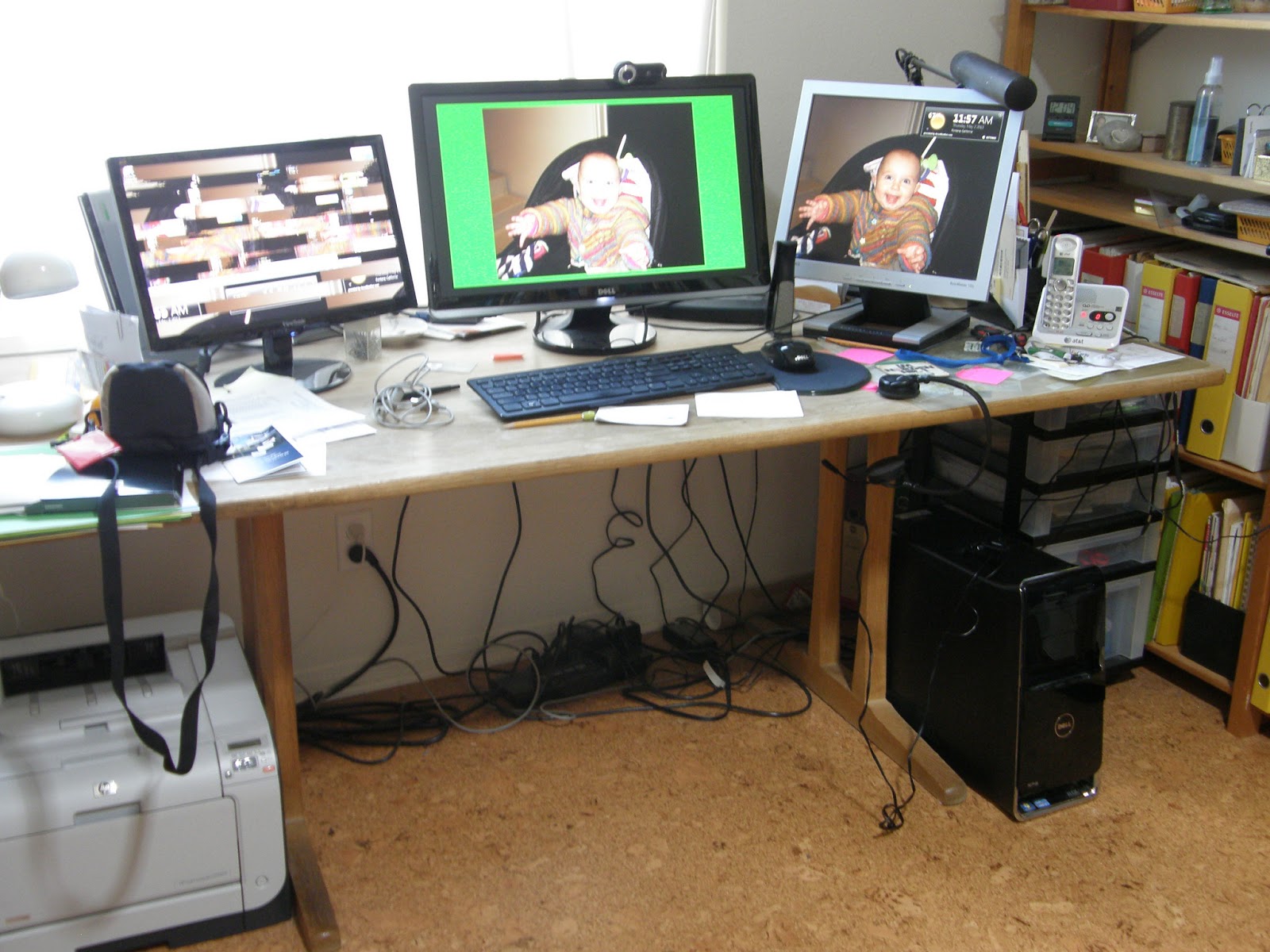
And gone are the days when I can call in a computer-savvy friend to fix what went wrong. I picked my current Dell desktop {which has just crashed 2 times since I wrote those words] because it had lots of USB ports, since almost everything, mouse, keyboard, external drives, scanner, headset, and even webcam and screens, have to plug into the computer through these ports - which is a great improvement, except that now there aren't enough ports for everything we used to use dedicated ports for.

And the big problem is, when it crashes, NO ONE has a clue what's causing it anymore. I know that because I finally got tired of having keyboard and mouse freeze (and scanner and the one screen plugged into the USB port, and the headset while I'm on Skype or Rosetta Stone) one or 2 at a time. Since I currently don't have a job, I don't even have access to my school's tech team, so I'm alone on this one.

It took me a long time to figure out that the problem was the USB ports, after paying the tech from Staples (less than a year after I bought it) $99 to run a test on it after the freezing began to happen with increasing frequency - as just now with about 2 minutes after restarting the computer.

And customer service doesn't work either

But some companies have gotten too big to serve their customers - Staples says the warranty (which has now passed) is with Dell, not them. I have been on the phone or chatted with tech support from Dell in India countless times (actually I have kept a log of the errors and a record of most of the contact with India.) Each person has taken over my computer, fixed something and let me go. After which Windows has decided that it needs to repair what they did and gone back to an earlier time. Twice a local tech has come to install parts - and it froze immediately afterwards.

What I want is a new replacement computer. What they want is to replace the hard-drive, or reinstall the OS, in either case losing all the installed programs, which I would have to spend hours locating and installing. With a new computer, I'd at least be able to transfer the major programs over a cable. Also, there is no way they're just going to take my hard-drive with all my personal information on it before I've wiped it clean. (I worked as a technical writer for a company that produced software to find hidden deleted files on computers, like porn and espionage, so I know that it has to be reformatted before I let it go!)

I have spent hours communicating with them, and waiting for my computer to wake up again; Dell's techs have spent hours communicating with me, and replacing minor parts in my computer. If they had replaced it as I requested at first, we would all have been saved enormous amount of time - which in my book is money. This is bad business practice for Dell, and I certainly will never buy their products again!

I have started a complaint with Better Business Bureau in Austin, but so far Dell holds tight, and is trying to keep correspondence away from BBB.

But my advice is, don't buy Dell. I'm not quite sure who one can trust with decent customer service. Some of my relatives say Apple. But I'm not ready to go there yet. We'll see.