We have books all over the house. A couple of weeks ago we saw an amusing cartoon about books, which I posted on FaceBook. Then my husband was inspired to go around photographing (almost) all the books we have in every room.
To get rid of those that have some current value, (mostly books for educators or students of science and math), I have an Amazon Sellers Account. Here are the books currently on my little bookstore shelves:
But I thought you might be amused at all those pictures my husband took around the house after seeing this cartoon:
Originally, we figured they'd all fit into the room we dubbed the Library/Music Room:
Our separate offices have our own books that would be of little interest to the other of us.
Here is John's office:
And here is mine, a couple of weeks ago:
We have a room divider with cookbooks in the kitchen, and a bookcase with biographies as well as one for books for the Little Free Library ended up in the dining room.
I finally decided to finish my short career as science and math teacher. It became very difficult to find jobs (maybe ageism had a role there.)
Also, I didn't think it was "fun" anymore. Students were more interested in checking out their laps, than working together in teams to learn. When I started all this, very few students had cellphones, so managing a classroom with 35 cellphones was not part of my teacher-ed curriculum. I tried everything various teacher-blogs suggested, including teaching students where to find useful math and science information and apps, but the last classes I taught used them instead to look up worksheets I sometimes used, to find the "correct" answer, or to text (almost always wrong) quiz answers to each other.
So now I occasionally help a student get over a hump in math or science, and otherwise spend a lot of time reading and learning languages. I've continued with Spanish, which I started in earnest to communicate with some of my students, and have also been playing with DuoLingo to learn some Modern Greek and Catalan (because we visited Barcelona last year.)
And the best part is my Little Free Libraries, both of them, one for little kids (above), and one for older kids and adults (to the left). I can't help reading book reviews for children's books, and trying to find them in used or otherwise inexpensive versions. So I've been reading Young Adult literature as well as grown-up books. And I enjoy talking with neighborhood kids as they select books as well.
I've also discovered the Book website GoodReads, and enjoy participating in book clubs there.
But I doubt I'll be back writing on my blog again. But you never know!
A new student from another school district wrote this for me soon after he arrived. He said he'd seen it on a poster in the District office. I love that a student can appreciate how hard we work!
In college I was truly split between the science career I'd been planning all through high school, and my new-found fascination with languages, historical linguistics, and just learning lots of languages, just to see how they worked. Although I can say I speak Danish fluently and German close to fluent (although not up-to-date!), I can also get along in French and communicate in something vaguely like Spanish with my students. But along the way I've also dabbled in Sanskrit, the holy language of the Hindi religion, as well as Greek, Latin, Lithuanian, Russian, Finnish (and a dab of its close relative, Estonian on a visit there) and recently Italian through RosettaStone and DuoLingo.
I also sing in the Claremont Chorale, play the piano, and was considered something of a folk singer in college, playing my guitar and singing songs of Pete Seeger andJoan Baez, as well as a variety of German, French and Russian folksongs. And then there are all the clothes I've made for my children and grandchildren (and their dolls). There's the diaper service I ran for 5 years in Denmark, too, and years as a technical writer. And now I'm back where I started, teaching chemistry and physics in high school.
Many of my students feel the same way. We have to support them to experiment with their lives, but also realize that they will have to earn a living some day.
One of my students is totally into dancing, and every day he manages to come to class he says "I hate being here, I hate school!" But if I can get him to answer a question, I know he's been listening, and then he's sometimes hard to stop. He answers all my questions before anyone else has a chance. He dominates his group on their activities, and even once admitted that he used to think he'd become a biochemist. But right now that dancing is all he can think of.
I have wanted to have a Little Free Library ever since I heard about them. Our home is situated perfectly for one, on a corner lot at the entrance to a small new subdivision with residents of all ages. When we had our front yard redone to make it even more drought-resistant, I asked the landscaper to put in a post for the library and ordered a "Purple Pickle" library from the website. Not only do the colors match some of the flowers in our yard, it was also a special, arriving with a package of 10 children's books.
We finally got it put up this week, and there has been movement in the book collection ever since. I put in a variety of children's books, including some wonderful kids' science books from the National Science Teacher Association, some books on how to make math easier for our teenagers and a few books for the parents and grandparents. We have loads of books, so I'm hoping we can send a lot of them through our community library!
The neat thing about the Little Free Library is that users can take a book and maybe replace it with something else. There is a constantly changing variety of books in our little library, which is fun to see. People took to it immediately.
As you can see in the picture, part of the new landscaping is a new path with a couple of steps and a little bridge over our "Arroyo Seco", which the kids have put to use as short cut and place to sit while looking at the books. It's as if our corner front yard has become public, at least for the children, which is fun to watch. I noticed that the library is a little high for the smallest children to see in, so I've asked the landscaper to make a step in front of it, which can also serve as a seat.
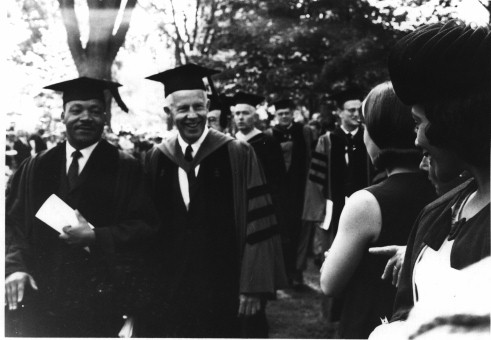
My class of 1965 reunion at Oberlin College was so inspiring, I've had a difficult time trying to figure how to write about it. Sort of like authors trying to write about their war experiences (Kurt Vonnegut's Slaughterhouse 5) or the death of a close family member (Joan Dideon's Year of Magical Thinking). Emotions need time to settle.
The early 60s were an exciting time, and the students of Oberlin College were right in the middle of it (although I stood mostly admiringly on the sidelines.) Therefore we were all issued caps at reunion with the motto, Semper Provocantes, which speaks well for many things in our generation. Oberlin students helped coal miners unionize to fight Big Coal - which I do now in connection with fighting Mountaintop Removal in the Appalachia I came to love while a student at the University of North Carolina. Others went all the way South to work with voter registration, and to rebuild a burnt church. You can read about some of that in this article: Memories of a Movement: Oberlin Alumni reflect on their time in the civil rights movement of the early 1960s.
I at least became a folk singer, and folk singers, like Joan Baez and Pete Seeger, who visited campus, sang protest songs. My repertoire was Pete Seeger and folk songs in languages I was studying, like German, French and Russian.
Because students from our campus were so active in voter registration, Dr. Martin Luther King presented the Graduation Address at our Commencement, calling it: Remaining Awake Through a Great Revolution. He told about how Rip Van Winkel slept through the American Revolution and was astonished at what he experienced when he awoke.
Dr. King's words are as important to us now as then, because there are many revolutions we are still fighting, some of which we didn't even think about back then. Women's Lib was not being discussed yet, nor were gay rights. We had some idea that we were messing up the environment because of Rachel Carson's Silent Spring, from the spring of 1962. But our concern was also awakening about the conflicts in the far East, which became the Vietnam War, maybe because some of us would be drafted to fight that war.
"We must live together as brothers, or die together as fools", Dr. King said.
But I think we have not yet learned to live as brothers (and is brothers really a good image? Maybe friends would be better.) There are still many revolutions, pitting brothers (and sisters) against each other, and our students must be prepared to understand what the revolutions are about, and to also understand that we must live together in peace if our world is to endure.
The Class of 2015 was almost as privileged as we were, because Michelle Obama spoke to them, quoting liberally from the words of Dr. King. You can read the transcript.
And the truth is, graduates, after four years of thoughtful,
respectful discussion and debate ...,
you might find yourself a little dismayed by the clamor outside these
walls—the name-calling, the negative ads, the folks yelling at each
other on TV. After being surrounded by people who are so dedicated to
serving others and making the world a better place, you might feel a
little discouraged by the polarization and gridlock that too often
characterize our politics and civic life.
And in the face of all of that clamor, you might have an overwhelming
instinct to just run the other way as fast as you can. You might be
tempted to just ... find a
community of like-minded folks and work with them on causes you care
about, and just tune out all of the noise. And that’s completely
understandable. In fact, I sometimes have that instinct myself—run! ...
But today, graduates, I want to urge you to do just the opposite.
Today, I want to suggest that... you need to run to, and not
away from, the noise. ... Today, I want to urge you to
actively seek out the most contentious, polarized, gridlocked places you
can find. Because so often, throughout our history, those have been
the places where progress really happens—the places where minds are
changed, lives transformed, where our great American story unfolds.
One alumnus (a lowly sophomore when I graduated) said.
"I think it's important for young people today to understand how much power there is in not knowing what you can't do." Charlie Butts, Oberlin College '67
That
is the glory of being young. You don't really accept "no" but try
anyway. I'm afraid many high school students have forgotten that,
though. Too many times have teachers and parents told them what to
think, what's right, what is expected of them, and they have lost their
curiosity, and believe the adults who say "it can't be done," or "it can only be done this way."
I think it is a very necessary role of teachers to awaken students' curiosity, not squelch it. Encourage students to join whatever revolutions they see, while preparing them to think clearly about the options available to them.
As a teacher, I want my students to be literate in science, since it is an important part of today's revolutions. I want them to be able to read and discuss and think and discuss some more. But I don't want them lost to demagogues who mislead them with pseudoscience, or incomplete interpretations of history. When we set students free at graduation, let them be prepared for the big and complicated and confusing world we have provided for them.
This is a great video that tells about the strategy I'm trying to use in physics:
Notice how the modeling concept works through these phases:
Model Development
Model Deployment
Model Failure
He talks about how modeling goes from the concrete to abstraction. I once tutored a student in Physics who had been a straight A student until Physics Senior Year. It turned out his teacher showed them how to derive equation after equation to define physics concepts, but the only labs they did were after the test, as a reward. The student and I figured out together how the concepts worked, and he started getting A's again!
For more information, look at the American Modeling Teachers' Association (AMTA), where members can find a full curriculum for Physics, Chemistry, Physical Science, and now also Biology. The speaker also mentions the Modeling website at Arizona State University, where the strategy originated.
Inspired by Nelson Mandela's claim that the impossible is just waiting to be done, this blog chronicles my own journey to do the impossible. I am embarking on another new career as a high school math and science teacher . . . and I don't really think it's impossible - just really hard these days to land a job. I finally became a credentialed "single-subject" teacher of math, science, physics, chemistry and biology in 2011--but finding the job to use my skills to help motivate students to enjoying my favorite subjects was difficult. I ended up at a different school each year. So I am now retired, but still working with some kids and books.
I have a number of books about teaching, math and science (and other books of interest) in my Amazon Seller Account. There might be something there that you could pick up at a reasonable price.